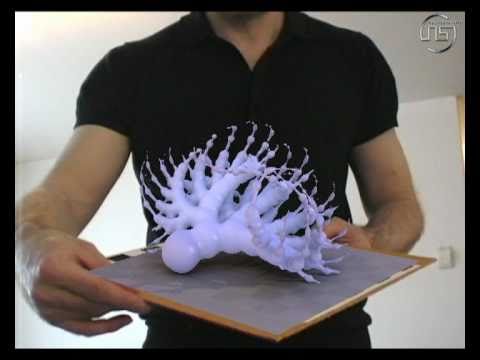
The idea that a kind of life exists in art and architectural form has repercussions for generative design using natural attributes, possible fusions of hybrid bacteria and mechanics, as well as synthesized life as part of design production. Additionally, philosophical and critical debate has, in developing theories of embedded cognition, created a different link, but one implicating form (thus shape grammars) as a potential carrier of lifelike qualities. While much has been made of Richard Dawkins’s articulation of memes as infectious, especially by Susan Blackmore’s Meme Machine, the idea for life in physical forms tracks back much further. As part of the research for this project I am going over critical and theoretical views to support ideas that learning design is enhanced with knowledge of natural, philosophical, and theoretical positions linking form and design with living systems. As part of the research I’m assembling data in the form of quotes that may or may not appear in the work, but that set inflections and influences for the research. Here are some idea-generating quotes from Henri Focillon’s 1992; 1934. The Life of Forms in Art (La vie des formes). Cambridge. Zone Books.
“Is this prodigy [work of art] merely a simple phenomenon of cultural activity in a chapter of general history? Or is it something added to our universe — an entirely new universe, with its own laws, materials, and development, with its own physics, chemistry, and biology, with its own engendering of a separate humanity?” P.32.
“Form inhabits the shortest wavelengths, no less than those of the lowest frequency. Organic life designs spirals, orbs, meanders, and stars, and if I wish to study this life, I must have recourse to form and to number. But the instant these shapes invade the space and the materials specific to art, they acquire an entirely new value and give rise to entirely new systems.” P.34.
“We are entirely justified in our assumption that such forms constitute and order of existence and that this order has the motion and the breath of life. Plastic forms are subjected to the principle of metamorphoses . . . “ P. 41.
“Models of nature may themselves be regarded as the stem and support of metamorphoses.” P.42. [Link here and above with Goethe, science, and his coining of metamorphoses — then tie into computation and the invention of simulated nature via Lindenmayer recursive maths for L-Systems.]
“The life of forms has absolutely no aim other than itself and its own renewal.” P.44. [Could bridge form with evolution, Darwin, survival.]
“But form is primarily a mobile life in a changing world. Its metamorphoses endlessly begin anew, and it is by the principle of style that they are above all coordinated and stabilized.” P.44.
“They [forms] mingle with life, whence they come; they translate into space certain movements of the mind. But a definite style is not merely a state in the life of forms, nor is it that life itself: it is a homogeneous, coherent, formal environment, in the midst of which man acts and breaths.” P.60. [“Movements of the mind” gives an opportunity to associate with embedded cognition.]